
What practices are prohibited?
The DMCC has imposed new prohibitions on misleading advertising with serious consequences for non-compliance. This includes a wide array of unfair commercial practices which were previously prohibited by the Consumer Protection from Unfair Trading Regulations 2008.
The offences capture misleading marketing which leads a consumer to do or not to do something. This could be as simple as the decision to visit a shop or click through to a website.
This means that advertising and user journeys which are misleading, or omit important information, are very likely to contravene the law.
There is also an expanded list of practices which are always considered unfair.
Why does this matter?
Misleading advertising and pricing practices are currently a major focus of the CMA and the risk of non-compliance for businesses is very significant. The CMA has direct enforcement powers including the ability to impose substantial fines. The first fine which the CMA has issued under its new powers was for £4.2 million, reduced from £7 million on the basis that the offending party settled quickly.
This is a major shift in enforcement powers. “Getting it wrong” now means significant fines whereas in the past only led to adverse ASA rulings and some reputational damage.
What areas are the CMA focusing on?
The provisions within the DMCC are broad and the CMA has significant flexibility in relation to how it flexes its muscles. This means that the CMA’s focus is likely to shift as commercial practices and consumer habits evolve.
The CMA’s current focus includes:
- Misleading pricing, including ‘drip pricing’ and misleading savings claims
- Misleading environmental claims
- False urgency claims
The CMA is monitoring compliance across the economy, and is using AI tools to detect unlawful practices. Our experts work across sectors and have many decades of experience helping clients to operate compliant advertising campaigns, price promotions and product pages.
Subscription contracts
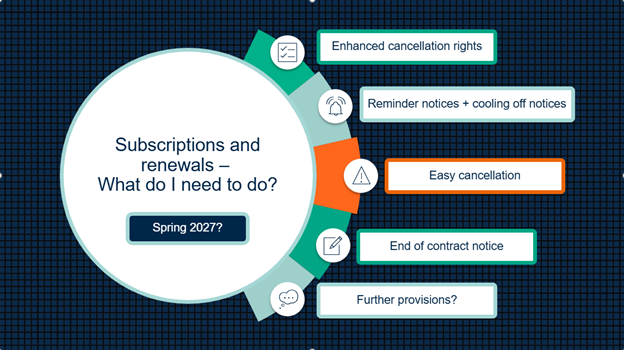
The DMCC introduces new duties on businesses offering subscription contracts. These obligations arise throughout the consumer’s journey, from initial promotion of the subscription, through to renewals, cancellation and post-termination.
Businesses offering subscriptions will be required to provide consumers with additional information at each stage of their journey. This should mean that consumers can make fully informed decisions about subscriptions. The obligations in the DMCC will be automatically implied as terms in any subscription contract with consumers for goods or services.
The new rules are expected to come into force in Spring 2027. However, businesses should review their subscription contracts now (not least because the CMA may investigate subscription contracts under current consumer protection laws before the new rules come into effect – see here).
Fake reviews
The DMCC includes several new offences relating to fake and misleading reviews including:
- Submitting fake reviews
- Commissioning fake reviews
- Publishing consumer reviews in a misleading way
Businesses also have new ‘active’ duties to take steps to avoid publishing fake or misleading reviews or hide the fact that someone has been incentivised to give a review.
The CMA continues to have a major focus on combatting fake reviews given that reviews are considered a key part of consumer decisions to purchase. This has been a long-standing focus of the CMA, including an investigation into the trade of fake and misleading reviews online in 2019 resulting in businesses making commitments regarding their future practices. The DMCC brings a renewed focus to this area.
It’s important that businesses can verify that the reviews they display are real. Our experts have a range of experience in helping businesses get the review process right – from shorter reviews to more in depth testimonials.
Environmental claims
‘Green’ or ‘environmental’ claims are within the scope of the UK consumer enforcement regime and ‘greenwashing’ is an area of focus for the CMA. Advertisers who make misleading green claims may face very substantial fines and claims from consumers for civil redress.
The ASA and CMA have already taken a robust approach to environmental claims, and it is clear that businesses require a high level of substantiation.
Further to issuing its Green Claims Code in 2021 – which sets out how businesses can publicise their environmental credentials without misleading them – the CMA has published a 2026 short explainer about what businesses need to know when making green claims.
The CMA has a track record of investigating environmental claims. In parallel, the ASA has made many findings that advertisers have presented their environmental credentials in a misleading manner.
Our experts have advised clients on green credentials and assisted clients with ASA investigations in this area across all sectors, from clothing to consumer goods, to energy.