



Addressing illegal harms: Online Safety Act
Have you shielded your service?
Summary
Watch our video on how to tackle illegal harms
The ‘illegal harms’ provisions of the OSA impose extensive obligations on in-scope service providers to identify, prevent and mitigate against illegal harms online. There is also a significant volume of material for in-scope services to get a handle on, between not only the prescriptive requirements of the OSA itself, but also the various guidance and codes of practice published by Ofcom.
To help break all this down and to assist in-scope service providers with meeting their OSA illegal harms obligations, we have simplified and summarised Ofcom’s key recommendations in our full article on this topic below.
In summary, compliance with the OSA can be separated into four phases as demonstrated in the chart below.
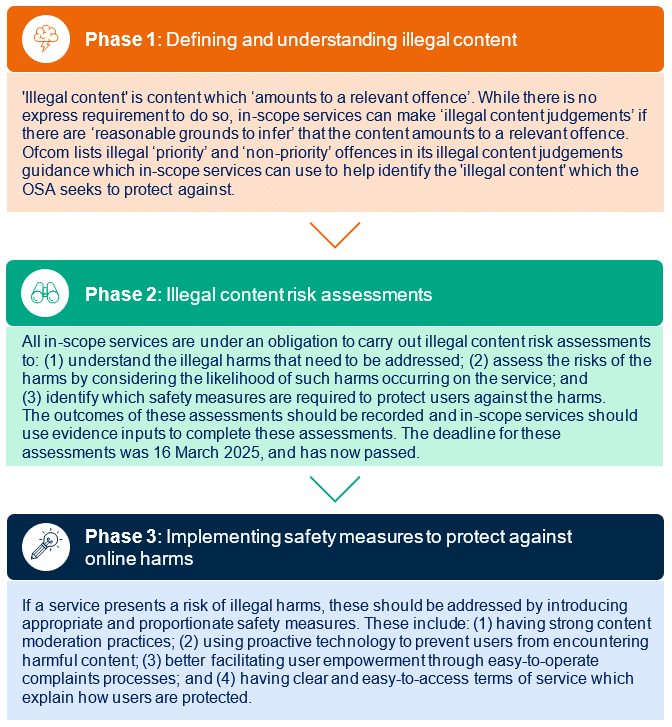
Have you shielded your service?

As the OSA made its way through Parliament, the provisions aimed at tackling online ‘illegal harms’ sparked considerable discussion. This discussion focused on the material the government proposed to classify as ‘harmful’ and whether this definition was too broad, and also on whether the far-reaching nature of the content removal obligations could result in censorship of online content (potentially stifling freedom of expression and information).
There is no denying that the illegal harms requirements set out in the OSA are extensive and onerous and that there is a lot for in-scope service providers to get to grips with.
In line with its obligations under the OSA, Ofcom, the regulator for online safety in the UK, has published helpful material which, while detailed, explains the practical steps that Ofcom expects in-scope service providers to adopt in order to comply with these ‘illegal harms’ requirements. These materials aim to provide some clarity in terms of the compliance measures service providers are expected to implement, including how they should approach: (1) categorising content as illegal, (2) assessing the risks of that content, (3) determining mitigating measures to adopt to limit the impact of the risks, and (4) demonstrating ongoing compliance with the OSA. The materials include:
- Regulatory documents and guidance which summarise and clarify the measures that in-scope service providers should implement to tackle illegal harms covering matters such as risk assessments, illegal content judgments, and enforcement.
- Codes of Practice on illegal content for user-to-user (‘U2U’) and search services which set out the steps that in-scope service providers should take to prevent users from encountering illegal content. While adherence to the codes is not mandatory, following them offers a ‘safe harbour’ for compliance with the OSA’s requirements, meaning that compliance with the relevant OSA provisions is essentially guaranteed. Service providers may choose alternative compliance measures, but they must ensure these are equally effective in mitigating illegal content risk, as they will not benefit from the safe harbour.
The most up to date versions of these documents can be found here.
In summary, the Illegal Content Codes of Practice offer specific, actionable recommendations for compliance, while the Illegal Content Guidance provides overarching principles and clarifications to assist platforms in effectively implementing the OSA's provisions.
In this article, we aim to assist in-scope service providers in digesting the available material and understanding their obligations under the OSA, by separating them into four distinct phases.
Phase One: Defining ‘illegal content’
A fundamental aspect of ‘illegal harms’ compliance for in-scope services will be to understand what ‘illegal content’ is and how to identify it. Essentially, this is content which ‘amounts to a relevant offence’; however, determining whether something constitutes a ‘relevant offence’ is not a straightforward assessment. The OSA therefore permits in-scope services to make ‘illegal content judgements’ if there are ‘reasonable grounds to infer’ that the content amounts to a relevant offence. This threshold of ‘reasonable grounds to infer’ is lower than the threshold (‘beyond reasonable doubt’) that is applied in the UK’s criminal justice system and may therefore result in a broader range of content being subject to moderation requirements.
This illegal content judgement should be made using all ‘relevant information that is reasonably available’. There is no express requirement for in-scope services to carry out these judgments; however, they can be a useful way of understanding whether any additional OSA ‘illegal harms’ obligations are likely to apply to the service.
To assist with carrying out this judgement, Ofcom has published Illegal Content Judgments Guidance which explains how providers can judge whether content is likely to be illegal. In this guidance, Ofcom lists ‘priority’ and ‘non-priority’ offences which would all constitute illegal content, but which carry with them different content moderation duties (see Phase Two for further detail). Schedules 5, 6, and 7 of the OSA list over 130 examples, which we have not listed; however, the offences have been broadly categorised by Ofcom, as set out in the table below. The list is updated from time to time, so we recommend reviewing Ofcom’s website periodically to ensure you are up to date on the latest allocations.
The above are categories of offences only and the guidance provides further key indicators and examples of each offence. There is an express obligation in the OSA requiring that the terms and conditions of the service provider’s website should prohibit all illegal content and a recommendation that providers may also wish to prohibit other categories of content.
Phase Two: Assessing the risks of illegal content
The OSA imposes obligations on all in-scope services (whether U2U or search) to carry out illegal content risk assessments. The purpose of the risk assessment is to improve a service provider’s understanding of how risks of different kinds of illegal harm (whether physical or psychological) could arise on the service, and what safety measures need to be put in place to protect users. These obligations vary depending on whether the service is search or U2U. In its guidance on risk assessments, Ofcom recommends adopting the below four step methodology to illegal content risk assessments.
- Step One: Understand the harms that need to be assessed. As part of this step, in-scope service providers should consider all of the different types of priority illegal content (see Phase One above) and identify whether there is a risk of each taking place on the service. In-scope services should consult Ofcom’s risk profiles for each priority offence. Further, U2U services should understand how a service may be used to facilitate or to commit a priority offence.
- Step Two: Assess risks by considering the likelihood and potential impact of harms occurring on the service. This step will require providers of in-scope services to assess the likelihood and impact of each of the priority offences, assess the different ways in which the service is used, identify any service-specific characteristics which may increase the risk, and consider the effectiveness of any existing controls that have been implemented. A ‘risk level’ should also be assigned to each of the priority offences. The risk level should be based on evidence inputs relevant to the service (e.g. user data including age, details of illegal content being complained about, results of product testing, and results of research / views of experts).
- Step Three: Implement safety measures and record outcomes of the risk assessment. As part of this step, in-scope service providers should consult Ofcom’s codes of practice and determine which measures are proportionate and recommended for the relevant service and whether any additional measures may be appropriate (see Phase Three below for further details on this exercise). If providers can demonstrate that they comply with the codes, they will benefit from a ‘safe harbour’ and compliance with the OSA will essentially be guaranteed. In-scope service providers can choose to comply with these requirements using alternative measures to those outlined in the codes (provided of course these are equally effective in mitigating illegal content risk).
- Step Four: Report, review and update the risk assessment in line with Phase Four below.
In each of the four steps listed above, service providers should also ensure that accurate written records are maintained, which not only evidence the conclusion reached, but also the various service characteristics that were taken into account. Risk assessments should be retained in line with a service provider's document retention policy or for a minimum of three years, whichever is longer.
Phase Three: Mitigating against the risk of illegal harms - key OSA duties
A core aspect of OSA compliance will be to implement appropriate measures to address any risks identified in the illegal content risk assessment. These measures are listed in Ofcom’s codes of practice which should be consulted by in-scope service providers (there are separate codes for search and U2U services). At a minimum, all in-scope services (whether U2U or search) should: (1) have strong content moderation practices; (2) better facilitate user empowerment through easy to operate complaints processes; and (3) implement a governance framework to oversee and ensure the effective implementation of risk mitigation measures. Ofcom recommends the following broad categories of mitigating measures:
- Search & Content Moderation: Both search and U2U service providers should implement general content moderation measures to swiftly remove, index, and re-rank illegal content. Further, larger providers of medium and high risk services will be required to make use of automated tools to make content moderation processes more effective and efficient. Ofcom expects that using such tools may require a tailored approach depending on the organisation and the type of content at issue, as set out in the below table.
| Type of content | Ofcom's recommendations |
| CSAM | Proactive detection tools e.g., hash-matching and URL tracking. |
| Hate speech and extremism | Carefully consider context to distinguish between legal expressions and illegal incitements. |
| Fraud and financial crime | Dedicated reporting channels for trusted flaggers (e.g. government agencies, regulators). Keyword tracking was suggested as a possible solution in the draft guidance, but following consultation responses that this was too rudimentary a tool, Ofcom is considering other appropriate measures to mitigate this risk. |
| Terrorism | Monitoring known symbols, language patterns, and accounts linked to proscribed organisations. Ofcom may also recommend hash-matching in future. |
- User empowerment: All in-scope services must have a complaints process and must take appropriate action in response to a UK user complaint. The process should be easy to use and must ensure that the complaint is acknowledged and that actions are taken in response to a complaint (e.g. removal or reinstatement of content, and an appeals process). Default privacy settings should be pre-emptively imposed on any child users of in-scope services. On the question of whether users who post illegal content should be blocked from accessing U2U services (rather than their content solely being removed), Ofcom recommends that an account should only be blocked where there are reasonable grounds to infer it is operated on behalf of terrorists. Finally, large and high risk services should ensure user controls are available to enable muting and comment-disabling, where appropriate.
- Service Design: Ofcom has provided the following substantive recommendations about the design of large horizontal search services (platforms that index and provide access to a wide variety of online content), when considering illegal harms:
- predictive search functionalities (where used) should offer the ability to easily report predictive search suggestions which appear to direct users towards priority illegal content;
- crisis prevention information should be provided by platforms in response to search requests that contain queries regarding suicide and suicide methods; and
- providers should have different means to detect and warn against search requests relating to CSAM.
- Terms of Service: All in-scope service providers should have clearly signposted, easy-to-access, and comprehensible terms of service which:
- explain how individuals will be protected from illegal content;
- provide information about proactive technology used to detect and moderate illegal content; and
- explain the policies and processes which govern the handling of complaints regarding the presence of illegal content.
Additionally, providers of ‘Category 1’ services (see our article on the scope of the act for more information regarding categorised services) should summarise the findings of their illegal content risk assessment in the terms of service.
- Governance & Accountability: All in-scope services will need to ensure that a governance framework is in place to ensure that risk management activities are reviewed on an annual basis. Further, all in-scope services should name an individual accountable to the most senior governance body for compliance with the illegal content safety duties and the reporting and complaints duties. For large and multi-risk services only (see our article on the scope of the act) for more information regarding these service types), additional governance and accountability measures should be adopted such as:
- tracking evidence of new and increased harms;
- putting in place a code of conduct that sets standards and expectations for employees around protecting users from online harm; and
- ensuring that relevant personnel involved in the design and operational management of the service are trained in the service provider’s approach to compliance with the illegal content safety duties.
Phase Four: Ongoing Compliance with the OSA
Once the assessment is complete and providers have taken steps to mitigate against the risks arising, this is not the end of the process. A core aspect of OSA compliance is to ensure that all risk assessments are continuously reviewed, updated, and that the effectiveness of the safety measures is monitored. Providers should therefore ensure that their illegal content risk assessment is kept up to date, and should review and update it:
- at least every 12 months;
- when Ofcom makes a significant change to its Risk Profiles; and
- if the provider is planning to make a significant change to its service (or in these circumstances create a new illegal content risk assessment).
If providers begin to notice new types of harmful activities appearing on their platforms they should remain vigilant and consider whether or not these activities could fall within the illegal harms categories set out within the OSA, and document their decision making.
Conclusion & Next Steps
Ofcom proactively drives compliance with the rules in the following ways:
- through supervisory engagement with the largest and riskiest providers to ensure they promptly implement compliance measures;
- pushing for improvements where needed;
- gathering and analysing the risk assessments of the largest and riskiest providers;
- monitoring compliance and taking enforcement action if providers have failed to complete their illegal harms risk assessment;
- early, focused engagement with certain high-risk providers to ensure they are complying with Ofcom’s CSAM hash-matching measure, which recommends the use of effective hash-matching measures to detect and remove CSAM; and
- further targeted enforcement action for breaches of the safety duties where serious ongoing issues are identified that represent significant risks to users.
Ofcom has already taken enforcement action against a number of providers for breaches (or alleged breaches) of the safety duties under the OSA, and we anticipate further action being taken as more priority offences are added to the OSA by the government. So it is important to remember that the illegal content risk assessments are not merely a paper exercise, and in-scope services must ensure that mitigating measures identified as part of these assessments are reviewed, tested and improved. This includes ongoing monitoring of Ofcom’s guidance and codes of practice to reflect their up to date recommendations.
Last updated: 13 October 2026
Authors